Blog Post
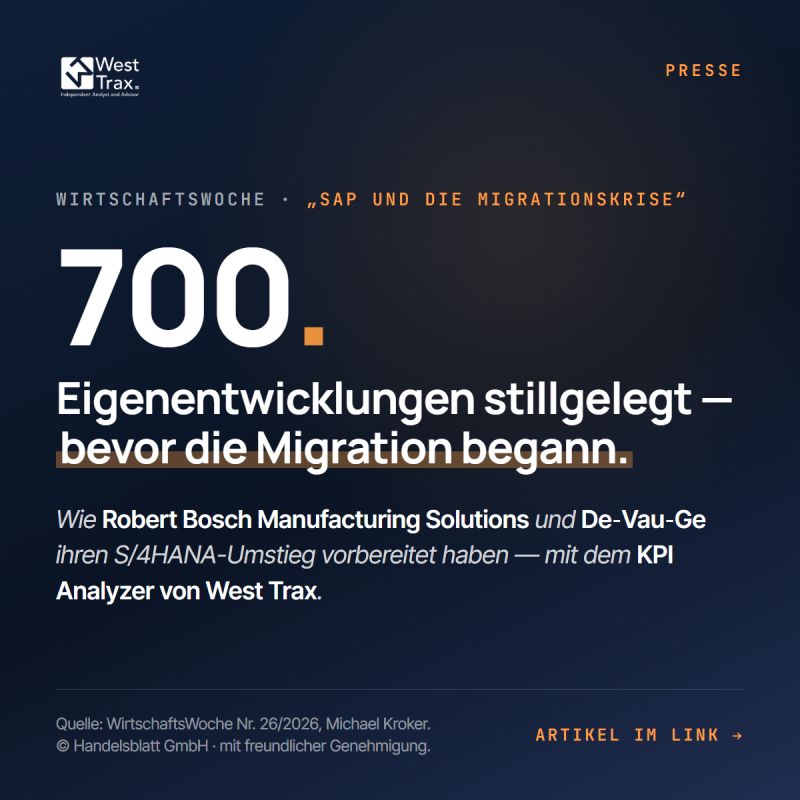

Many companies believe that the real work only begins with the S/4HANA migration.
Practical experience shows otherwise.
In the current issue of WirtschaftsWoche, Michael Kroker describes two companies that made their greatest progress even before the actual transition.
What the examples show
At Robert Bosch Manufacturing Solutions, the West Trax KPI Analyzer analyzed an SAP ECC landscape that had grown over 25 years.
The result:
• Over 820 custom developments were examined.
• Around 700 of them no longer provided any business value.
• The analysis took just a few hours – manually, according to Bosch, it would have required several months.
De-Vau-Ge also followed the same approach.
The subsequent S/4HANA transition was achieved with just three developers in seven months – without any disruption to production.
The key concept:
Clean up as much as possible in the legacy system before the actual transformation begins.
The greatest efficiency is created before the migration
Both examples show the same pattern.
It is not the migration itself that creates the greatest efficiency.
Rather, it is the transparency about
• which custom developments are actually used,
• which of them have long since ceased to provide any value,
• and what complexity does not even need to be carried over into the new system world.
Assumptions turn into facts.
Complexity turns into clarity.
That is why successful transformation begins earlier
Those who know the reality of their system reduce risks, shrink the scope, and create a reliable foundation for budget, roadmap, and go-live.
This is precisely why a layer of facts is needed between system reality and decision-making.
We call it the Decision Intelligence Layer.
Clarity instead of flying blind.
We have acquired the usage rights to the full WirtschaftsWoche article: