Blog Post
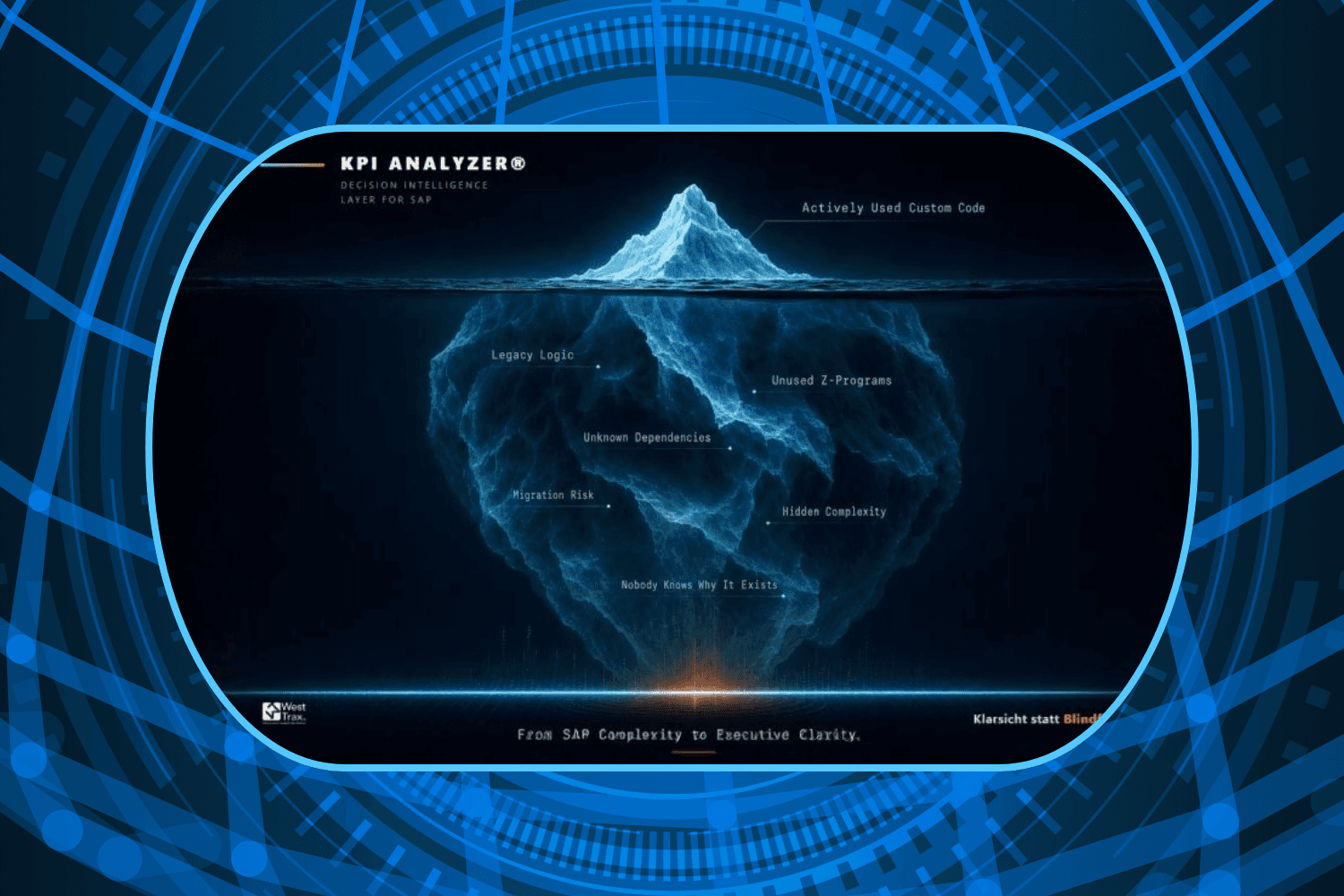

In most SAP systems, hundreds — often thousands — of custom developments exist.
But only a small portion of them is used regularly.
The rest has not disappeared.
It is just invisible.
The real risk lies below the surface
From over 2,200 analyzed SAP systems, we keep seeing the same pattern:
Above the waterline are the known programs:
• actively used
• anchored in business processes
• documented — at least partially
Below that, however, begins the area,
which in many transformations becomes the real risk.
The invisible layer of the SAP landscape
Below the surface, there are often:
• legacy logic without a business owner
• Z programs with no discernible use
• technical dependencies that no one fully understands anymore
• code whose existence no one can justify today anymore
And that is exactly where the most expensive decision in many S/4HANA programs arises.
“Better take it with us” is not a strategy
In many projects, the decision is made implicitly:
“Better take everything with us. Better safe than sorry.”
The problem:
This creates flying blind in the transformation.
Complexity is not reduced —
it is simply carried forward.
Clarity begins at the waterline
The key question is not:
How many custom developments exist?
But rather:
• Which of them still support real business today?
• Which are actually used?
• Which only create technical burden?
Only this transparency creates a sound basis for:
• Clean Core
• S/4HANA migrations
• Public cloud strategies
• standardization
• risk reduction
Clarity instead of flying blind
Our approach remains deliberately simple:
• Read-only transport
• around 60 minutes initial effort
• results as early as the next day
Without intervening in the productive system.
Without workshop marathons.
Only with a clear view of what is actually below your waterline.
👉 A short message is enough — we will show you what lies below your waterline.