Blog Post
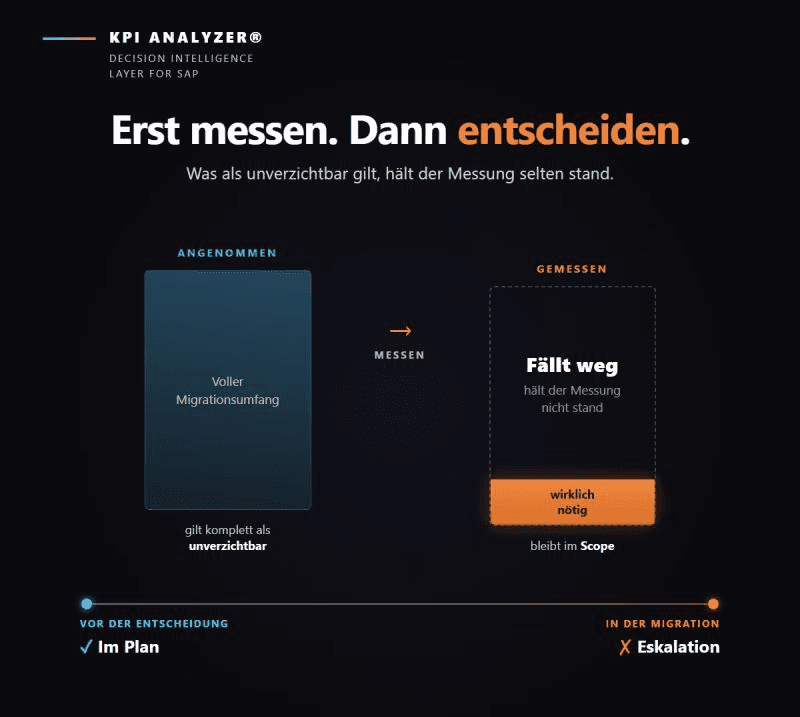

In most SAP transformations, exactly the opposite happens.
First, the budget, scope, and go-live dates are set.
Measurement happens only later – when the migration is already underway.
Yet, the sequence can be designed in a much more sensible way.
Why facts should come before decisions
Those who measure first replace assumptions with reliable data.
Not:
"The process runs as documented."
But rather:
These process variants are actually being used.
Not:
"We probably need the custom developments."
But rather:
These custom developments are actively used – and these have not been used for years.
Not:
"The scope of the migration is fixed."
But rather:
This share of the system is actually used and justifies the scope.
The reality often looks different
Based on over 2,200 analyzed SAP systems, the same pattern emerges time and again:
A significant portion of what is deemed indispensable at the beginning of a transformation does not hold up to an objective analysis.
Programs, processes, and custom developments considered business-critical are sometimes hardly used or not used at all.
As a result, the actual scope of the transformation often changes.
And significantly so.
The known gap does not disappear
The discrepancy between assumption and reality remains.
We are often talking about a 30 to 60 percent difference between the assumed and actual state of a system.
However, the crucial difference is:
Is this gap recognized early or late?
In the plan or in escalation
If a discrepancy becomes visible early, it ends up in the project plan.
If it becomes visible late, it ends up in:
• Change requests
• Budget discussions
• Postponed deadlines
• Escalations
It remains the same information.
But the impact is completely different.
The most expensive surprises are those no one planned for
A known discrepancy is plannable.
An unknown discrepancy becomes expensive.
That is why real added value does not come from more assumptions or additional workshops.
But rather from a reliable basis of facts before the decision is made.
Decision Intelligence for SAP Transformation
Exactly for this reason, a layer is needed between system reality and management decision.
A layer that makes visible:
• what is actually used
• which custom developments are relevant
• where standardization is possible
• what risks and potentials actually exist
We call this layer the Decision Intelligence Layer.
Independent.
Read-only.
Without implementation interests.
Without licensing interests.
Clarity instead of flying blind.
👉 If you are facing an SAP transformation, it is worth asking a simple question: Are you already making your decisions based on facts – or still on assumptions? Feel free to contact me for an exchange of ideas.