Blog Post
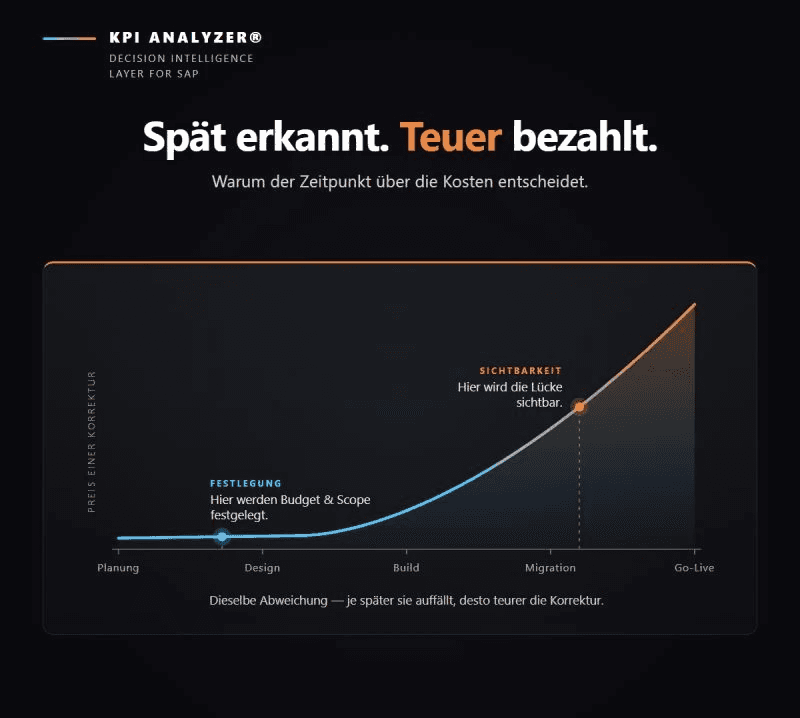

In many SAP transformations, it is assumed that large deviations automatically cause large problems.
The reality is different.
It is not the size of a deviation that makes it expensive. But the moment it becomes visible.
Decisions are made early
Budget, scope, and go-live dates are usually defined very early.
At a time when often no one has yet verified:
• how the system is actually being used
• which custom developments are business-critical
• which processes are actually lived
The planning is set.
Reality comes later.
When the system suddenly speaks up
Months after the project starts, the same situations often arise:
A process that the target design does not even foresee – but which the business departments use every day.
A custom development that does not appear in any project plan – without which a migration is impossible.
A scope that was considered decided – and suddenly has to be rediscussed.
The surprise seems new.
In fact, it was there from the beginning.
The problem was never the deviation
The deviation was already in the system.
It was simply not recognized.
And that is precisely why it becomes expensive.
Because in the meantime, decisions have already been made regarding:
• contracts
• resources
• budgets
• project dates
What would have been a simple planning item early on becomes a project risk later.
Identified earlier, different impact
If the same deviation becomes visible early:
✔️ it ends up as a task in the project plan
If it is. only recognized late:
❌ a change request is created
❌ an escalation arises
❌ a budget discussion occurs
❌ or a postponed go-live
A pattern that has repeated for years
From 25 years of SAP transformation reality, the same picture emerges time and again:
The gap was almost never new.
It was merely made visible too late.
And that is precisely why many of the most expensive surprises do not arise during the project.
But long before.
First the facts, then the determination
This sequence can be reversed.
Instead of making decisions first and discovering the reality later:
First the facts. Then the determination.
This requires a layer between system reality and management decision-making.
A layer that makes visible:
• how the system is actually being used
• where the relevant deviations lie
• what risks and potentials truly exist
Decision Intelligence for SAP Transformation
It is precisely this layer that we call the Decision Intelligence Layer.
It creates transparency before budgets are locked in.
It makes risks visible before they become problems.
And it replaces assumptions with reliable facts.
Clarity instead of flying blind.
👉 Which deviations are already hidden in your system today often becomes apparent within a few days. Feel free to write to me if you would like to know what your actual system reality looks like.