Dec 11, 2025

Why the actual relevance is often significantly smaller than the perceived one
Many companies assume that their custom code landscape is extremely complex.
Statements like "Our system is completely customized" are something I hear regularly.
However, the data almost always tells a nuanced story.
1️⃣ A large portion of in-house developments is no longer used
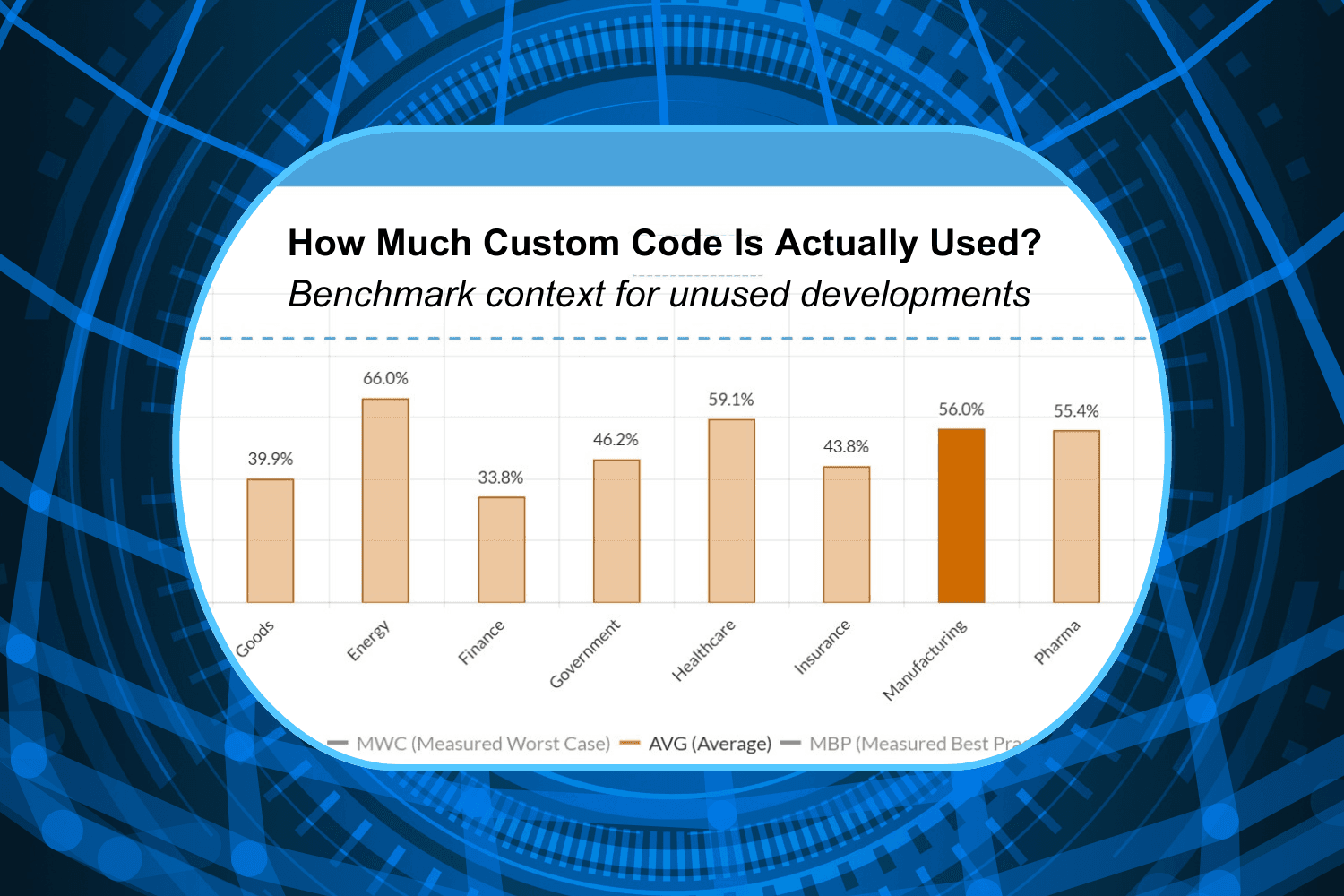
Industry benchmarks – for example, in manufacturing – show:
About 56 % of all custom developments are no longer utilized.
In the customer example shown, the figure is even 85.3 %.
Higher than the benchmark, but with the same pattern:
A lot was built – little is still needed.
2️⃣ The share of heavily used custom codes is surprisingly small
The average value in many industries is about 15 %.
In the analyzed customer system, it is only 3.7 %.
What does this mean for transformation projects?
Yes – many systems contain a large amount of in-house developments.
But: The relevant complexity, meaning the part that still delivers real business value today,
is usually significantly smaller than one would expect.
This leads to:
• clearer risk assessments
• more realistic project sizing
• fewer technical legacies in the core
• and often to a faster, safer project launch 🚀
Right now, as many programs head towards 2027 or 2030 milestones, this kind of transparency is extremely helpful for clean planning towards 2026.